Most people think of stress as something purely mental — thoughts, pressure, emotions. But stress is also deeply physical. The body records it, holds it, and over time it begins to shape how we feel, move, and function.
When we experience stress, the nervous system activates a natural survival response. This is designed to protect us. However, when stress becomes frequent or unresolved, the body may not fully return to balance. Instead, it can remain in subtle patterns of tension and protection.
Over time, these patterns can accumulate as what is often referred to as stored stress. This may not always be consciously noticeable, but it can influence breathing, energy levels, sleep, digestion, and overall sense of wellbeing.
The nervous system plays a central role in this process. When it is regulated, the body can move flexibly between activation and rest. When it is overwhelmed, it may remain stuck in states of alertness or shutdown, affecting how the entire system functions.
In approaches such as Spinal Flow, the focus is on supporting the nervous system to release these patterns of stored stress. As this happens, the body is given the opportunity to return to balance and ease in a natural and non-forced way.
When stress begins to release, people often notice subtle shifts — a sense of lightness, more space in the body, easier breathing, and a deeper sense of connection within themselves.
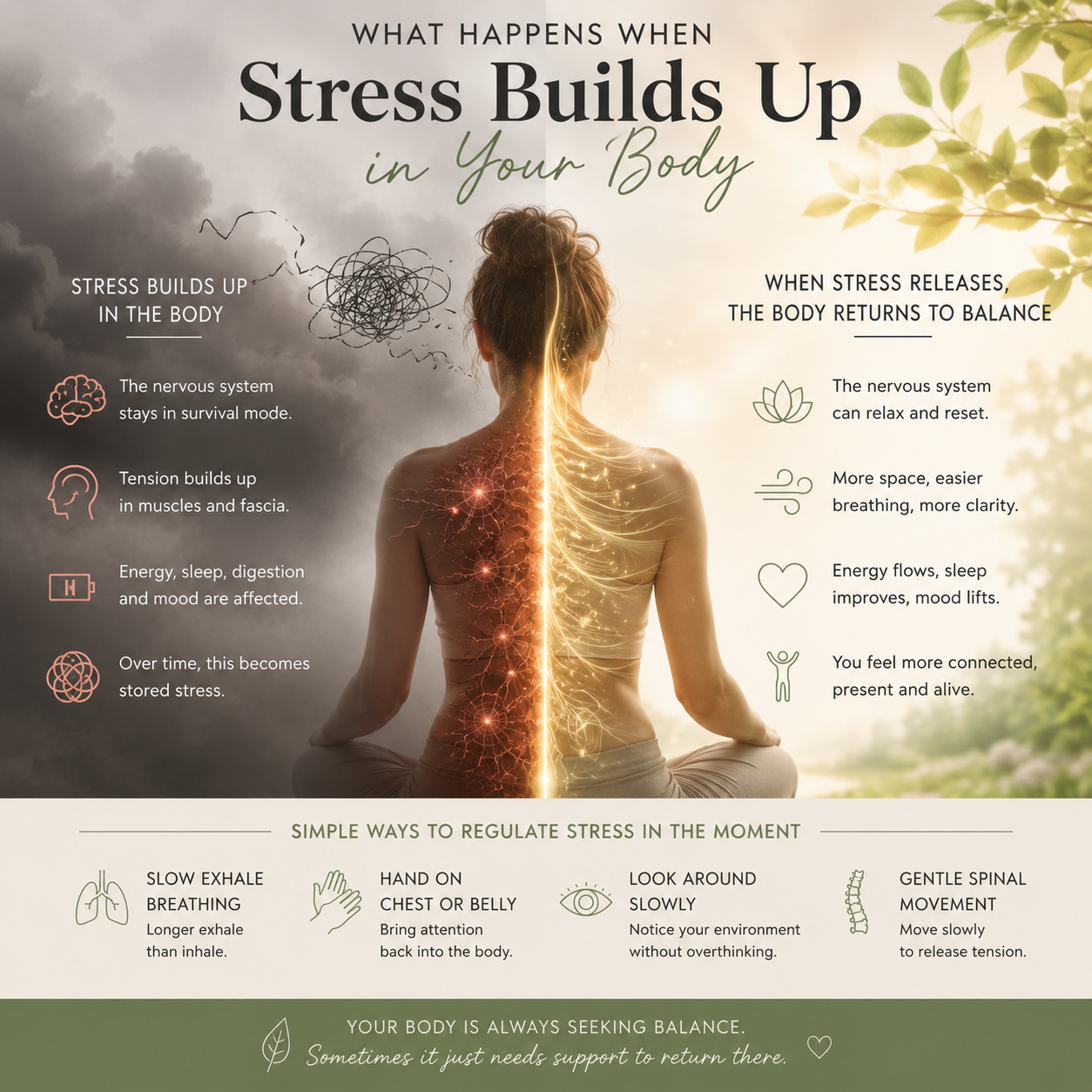
Simple tools to help regulate stress in the moment
You don't need to fix stress. Often, the body responds best when it is simply given signals of safety.
Here are a few simple practices you can try:
1. Slow exhale breathing
Inhale gently through the nose, and extend your exhale slightly longer than your inhale. This sends a direct signal to the nervous system that you are safe.
2. Hand on chest or belly
Place one hand on your chest or abdomen and simply feel the contact. This helps bring awareness back into the body instead of the mind.
3. Orienting (looking around slowly)
Slowly look around your environment and notice details without analysing them. This helps the nervous system recognise that there is no immediate threat.
4. Gentle spinal movement
Slowly move your spine — small waves, twists, or gentle rolling movements. This can help release physical tension patterns held in the body.
The body is not designed to stay in stress. It is constantly seeking balance. When it is supported with awareness, space, and simple regulation, it naturally begins to shift back toward ease.